Why don't ten tosses guarantee five heads? How can frequent wins still leave you losing money? Start with small questions, learn to calculate chances, and consider what the outcomes cost.
Basic arithmetic is enough to begin. Inspired by Taleb's thinking on risk: examples first, formulas explained.
List the outcomes·State the conditions·Ask what you can afford to loseP(A)
I The main course
Probability Made Easy with Taleb
Sixteen chapters, three exercises each, and answers at the end. Read from the start or choose a question that interests you. The experiments below accompany the book.
Start with 10 chips. Win or lose one per step, stopping at 20 or 0. The default win probability is 50%; move the slider to change it and compare outcomes.
Random walk / ruin and targetStart: 10 chips
Current path
This gameStart: 10Target: 20Ruin: 0
III An easily confused idea
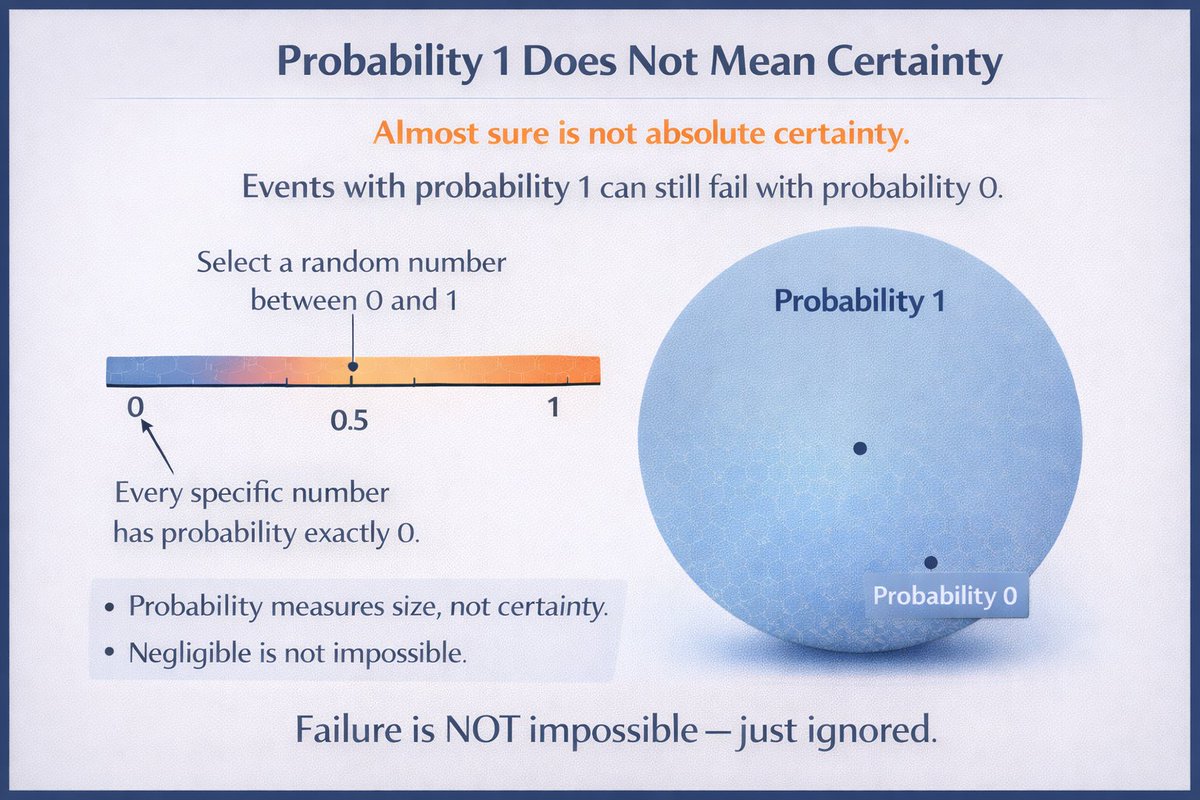
Probability 1: how can exceptions remain?
Choose a real number uniformly from 0 to 1. Selecting exactly 0.5, specified in advance, has probability 0. Yet 0.5 is still an available outcome. Probability zero and an empty event are different things.
Almost surely
If event A has probability 1, its failure has probability 0. But there may still be outcomes where A fails. “Not selecting 0.5” has probability 1 while excluding the possible outcome 0.5.
Every face of a fair die has positive probability, so a probability-1 event must include them all. In a continuous model, a point has no length and can have probability 0.
This diagram assumes uniform sampling from the real interval from 0 to 1. “Ignored” means assigned probability zero, not removed from the possible outcomes.
Try another example
An exception can exist with probability zero.
P(A) = 1
Uniform choice from 0 to 1
A number is chosen, but a specified point has probability 0.
Here probability follows interval length. A point has no length, so choosing exactly the prespecified number 0.5 has probability 0. But it remains available, and every draw selects a particular number.
P(X = 0.5) = 0 · P(X ∈ [0,1]) = 1
Zero means exactly zero here. Why can every point have probability 0 while the interval has probability 1? Chapter 14 explains why not all infinite collections can be summed like finite ones.
“Probability 1 can allow exceptions” is a claim within a probability model. Classical Reformed confessions instead say that true believers may fall temporarily but will not finally be lost. The shared language of certainty does not make these the same claim.
Distinguish whether someone truly is elect from whether we can know that accurately. Chapter 14 contains the full discussion, a comparison of terms, and the confessional sources.
Play the three-door game repeatedly, or change the three percentages in the testing example. Observe how the results change, then turn to the book for the calculation.
LAB 02
Three doors
Choose, then decide whether to switch
A prize is placed randomly behind one door; the other two are empty. Choose a door. The informed host always opens an unchosen empty door and offers you the chance to switch.
Choose a door first.
The key idea
The host knows where the prize is and must avoid revealing it.
Simulation results will appear here.
LAB 03
After a positive test
Count the people
Suppose 10,000 people are tested. Move the sliders to see how many positive results are genuine cases and how many are false alarms.
Among positive results, the proportion genuinely ill16.7%
The key idea
The fraction of cases detected is different from the fraction of positives who are genuine cases.
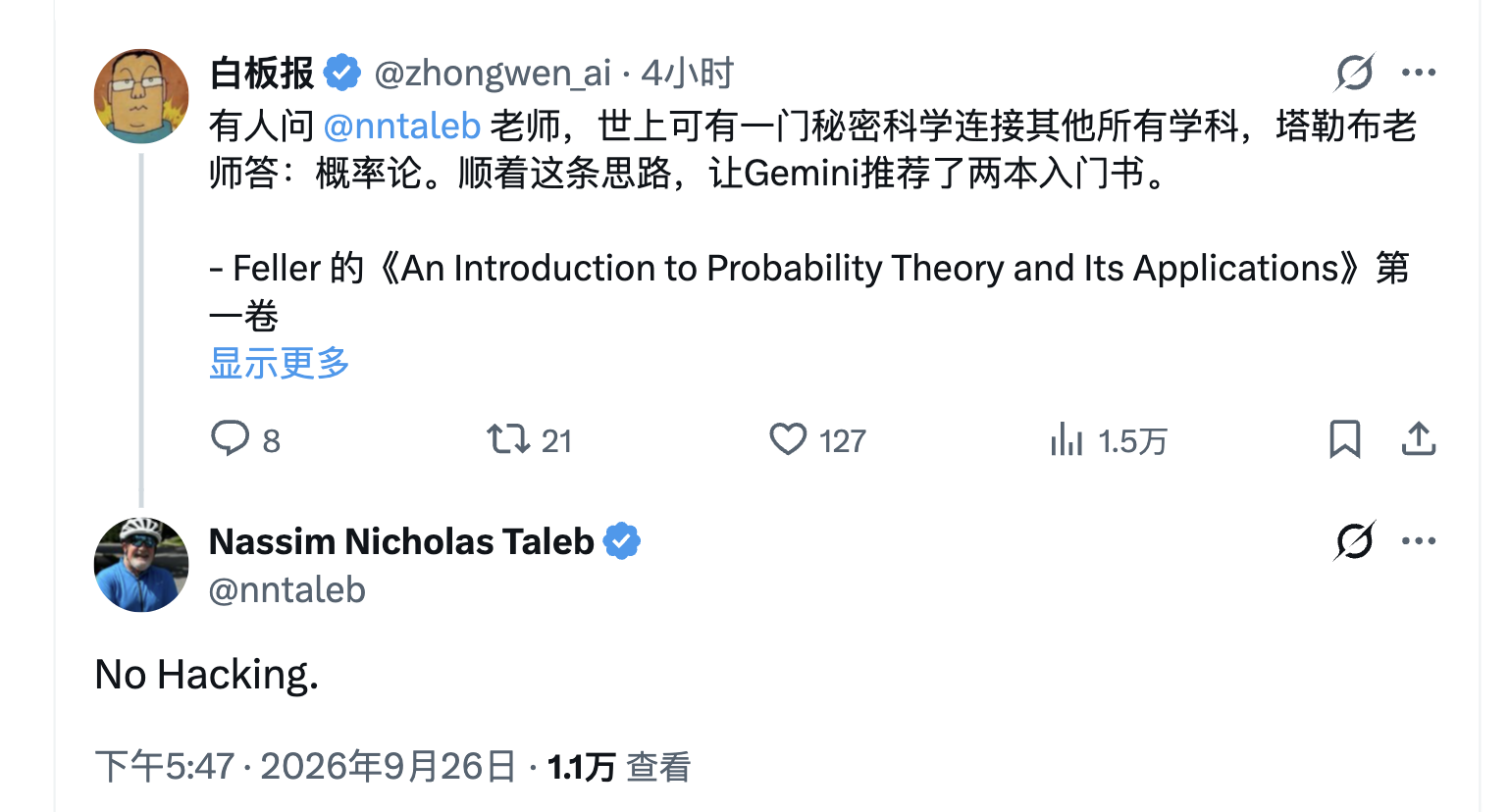
What does “No Hacking.” mean?In the context of the reading list, the natural interpretation is that he objects to including Hacking. The reply gives no reason. The appendix discusses what can and cannot be inferred.Sources and explanation in the book ↗
05 Choose by interest
Taleb's library A provisional reading list
Compiled from a shelf-identification list supplied to this project, not yet verified book by book. Each entry includes an introduction, prerequisites, and this site's rating.
About the listTaleb wrote Dynamic Hedging and the fat-tails monograph listed here. Owning a book does not establish a recommendation, and the ratings below are not his ratings.Taleb's CV ↗Fat-tails research ↗
Analyze data over time
Time Series Analysis
Study patterns in monthly or yearly observations. Prior statistics and calculus are recommended.
Understand complex change
Nonlinear Dynamics and Chaos
Explore complex behavior through oscillation, growth, and other concrete examples. Some calculus is needed.
Study statistical inference
Statistical Inference
Learn how samples can inform estimates of populations and tests of hypotheses. Requires calculus and probability.
Study financial markets
The Econometrics of Financial Markets
Learn to test market theories with financial data. Best with a background in statistics and economics.
Understand rare, large losses
The Statistical Consequences of Fat Tails
Study how extreme outcomes affect averages and statistical judgments. An advanced read requiring mathematical preparation.
Ratings are out of 5, based on relevance to this site's subjects: 5 means a priority recommendation, 4 recommended reading, 3 broader exploration, and 2 a specialist interest. A high rating does not mean an easy book: check the prerequisites. “Derivatives” has not been identified precisely and is rated provisionally by subject only.
Selected titles · filter by subject
Book index
Titles and authors follow the supplied list; editions still need checking. “Derivatives” does not yet identify a specific book.
Understand one problem properly
List the possible outcomes, then consider what each would mean.